Elegant IT
LinkedInFacebookTwitter
AI AgentsPricingFounder Notes

What an AI Agent Costs to Build in 2026, and to Run

An AI agent costs between $5,000 and $400,000 to build in 2026, and that spread is honest. A single-task workflow agent sits at the bottom. A multi-agent system in a regulated industry sits at the top. Here is what moves the number, what most quotes leave out, and what the agent costs to run every month after it ships.
AT
A.B.S. Tamal, Founder, Elegant IT Limited
8 min read · Published September 15, 2026
AI agent development cost in 2026 ranges from $5,000 to $400,000 depending on scope

$5,000 to $400,000. That is the real range for AI agent development cost in 2026, and it is not a vendor being vague. The same 4 words, build us an agent, describe a $6,000 email triage bot and a $300,000 claims processing system. Until the scope is pinned down, every quote you get is a guess about a different product.

We have shipped 315 products since 2017. This is the version of the answer we give founders on the first call.

The short answer, by tier

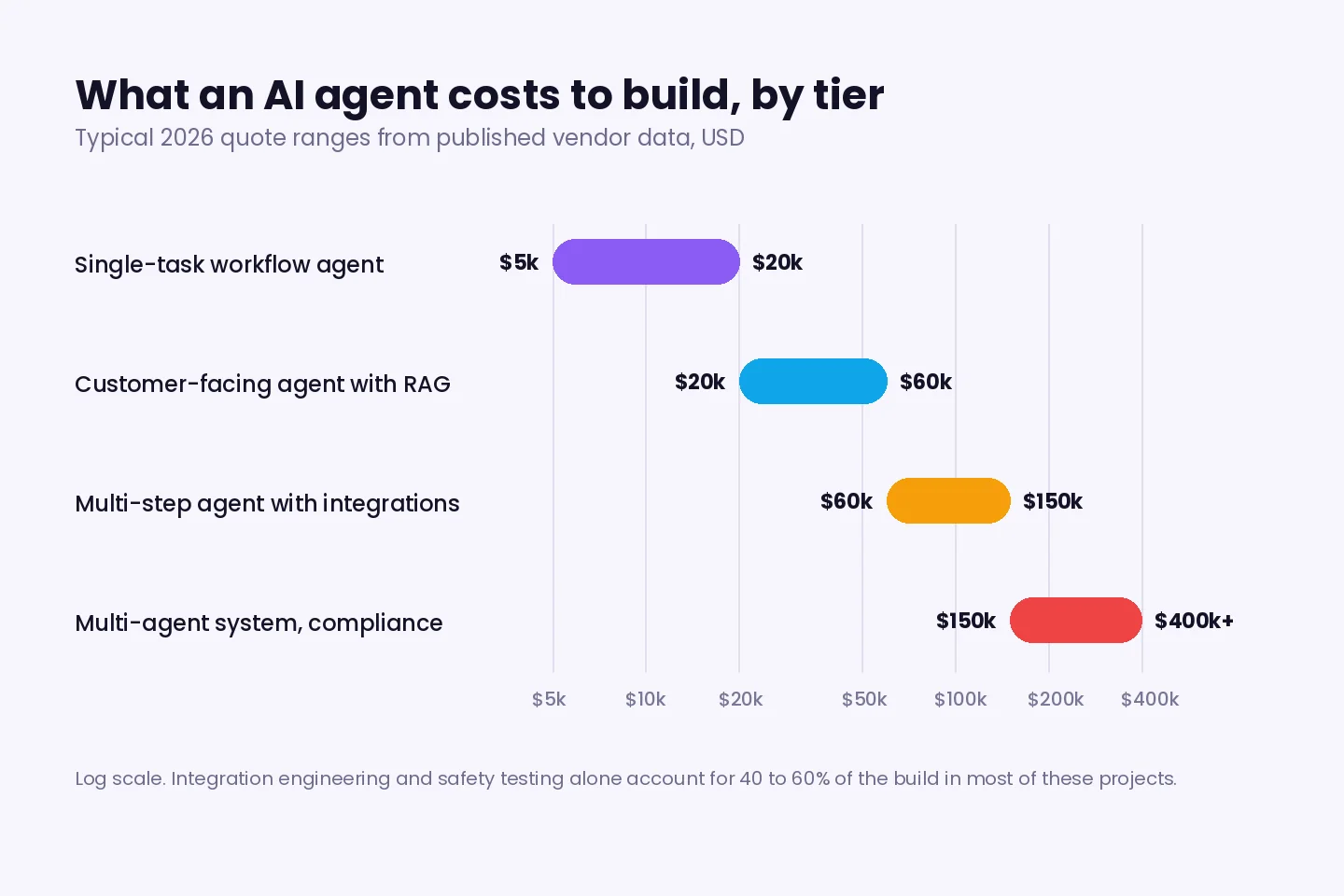
Published 2026 vendor pricing clusters into 4 bands. A single-task workflow agent that reads a document, classifies it and routes it runs $5,000 to $20,000. A customer-facing agent that answers from your own knowledge base with retrieval runs $20,000 to $60,000. A multi-step agent that has to call your CRM, your billing system and a human when it gets stuck runs $60,000 to $150,000. Multi-agent systems in regulated industries start near $150,000 and pass $400,000.

Healthcare and fintech carry a 25 to 40% premium on top of whichever band you land in. That is audit logging, consent handling and compliance review, and it does not go away because the model got cheaper.
Agent type2026 build costWhat it includesTimeline
Single-task workflow agent$5,000 to $20,000One job done well: classify, extract, route. Basic guardrails, one integration, simple monitoring2 to 4 weeks
Customer-facing agent with RAG$20,000 to $60,000Retrieval over your documents, conversation memory, handoff to a human, evaluation set, brand voice tuning5 to 8 weeks
Multi-step agent with integrations$60,000 to $150,000Tool calls into CRM, billing, ticketing. Approval flows, retries, cost guards, audit trail8 to 14 weeks
Multi-agent system, regulated$150,000 to $400,000+Orchestration across agents, compliance review, data residency, red-team testing, SLAs3 to 6 months

Ranges compiled from 2026 vendor pricing pages and our own quotes. Healthcare and fintech add 25 to 40% to any band.

Why 3 quotes come back 3 different sizes

The model is the cheapest part of an agent. In most of these projects, integration engineering and safety testing together account for 40 to 60% of the build. That is the number founders find hardest to believe, so here is where it goes.

Integrations. An agent that only talks is a demo. An agent that updates a record in your CRM, creates an invoice and books a slot in someone's calendar has to handle 3 APIs, 3 auth flows and 3 kinds of failure. Each integration is a week of engineering on a good day.

Data readiness. Retrieval is only as good as the documents behind it. If your help center has 4 versions of the refund policy, the agent will quote all 4. Cleaning that up is real work and it is almost never in the first quote.

Evaluation and safety. A production agent needs a test set of real questions with known good answers, run on every change. Without it, you find out about regressions from customers. Building that set and the harness around it is 1 to 2 weeks that cheap quotes skip.

Human handoff. The moment the agent is unsure, what happens? Who gets the ticket, with what context, and how does the customer know? This is UX work, and it decides whether the agent gets used or gets switched off in month 2.

Compliance. If the agent touches health data, payments or anything under GDPR, add audit logs, retention rules, consent and a review with someone who has done it before. This is where the 25 to 40% premium comes from.

Chart of AI agent build cost by tier in 2026, from $5k single-task agents to $400k+ multi-agent systems

The bill nobody puts in the proposal

The build cost is a one-time number. The running cost arrives every month for as long as the agent is live, and it depends almost entirely on which model you pick.

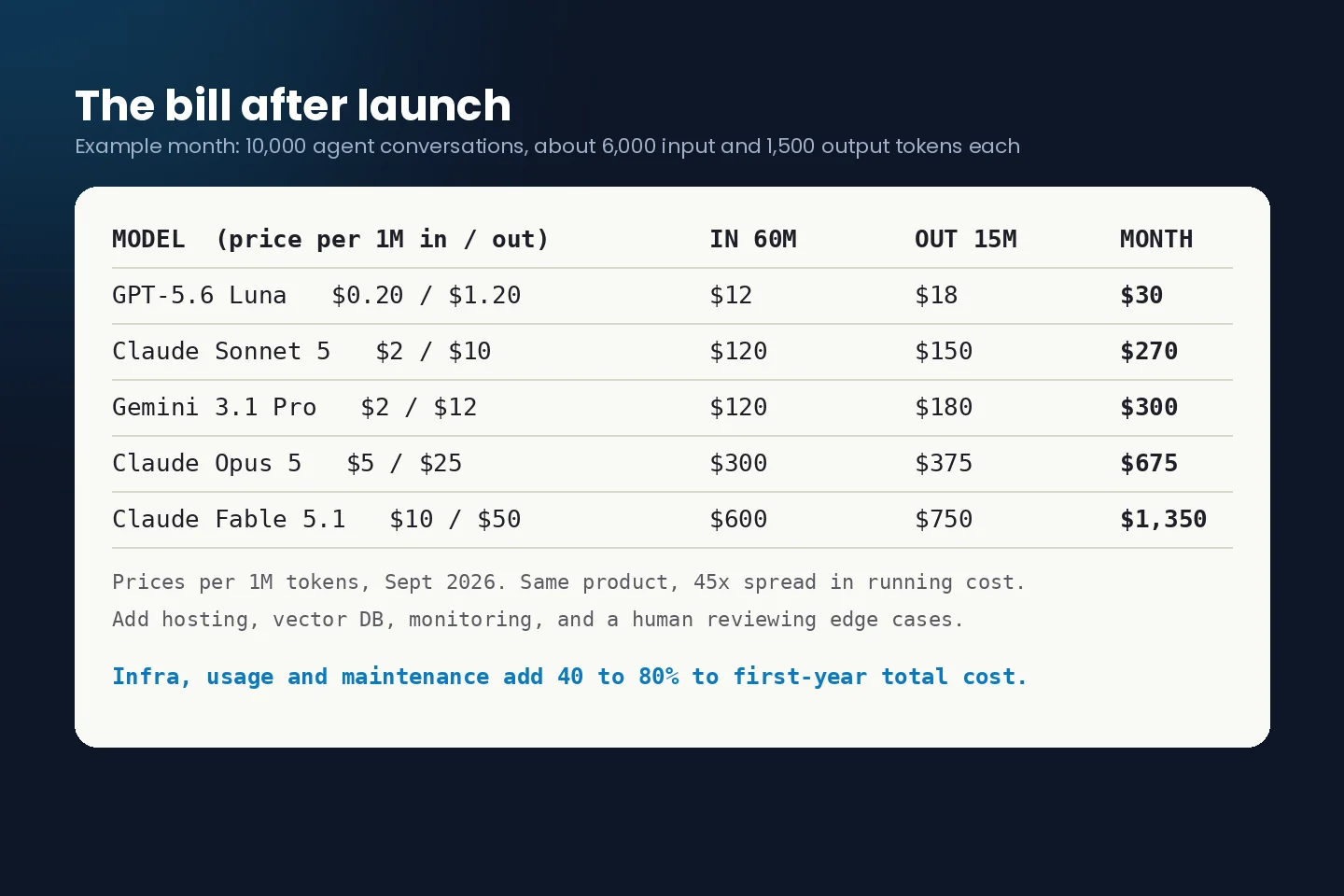
As of September 2026, published API prices per 1 million tokens look like this. GPT-5.6 Luna at $0.20 input and $1.20 output. Claude Sonnet 5 at $2 and $10. Gemini 3.1 Pro at $2 and $12. Claude Opus 5 at $5 and $25. Claude Fable 5.1 at $10 and $50. Prices fell roughly 80% between early 2025 and early 2026, and the $2 input tier is now where 3 of the major labs compete.

Take a realistic month: 10,000 conversations, each using about 6,000 input tokens once you include retrieved context and system prompts, and about 1,500 output tokens. That is 60 million tokens in and 15 million out. On GPT-5.6 Luna the bill is about $30. On Sonnet 5 or Gemini 3.1 Pro it is $270 to $300. On Opus 5 it is $675. On Fable 5.1 it is $1,350. Same product, same traffic, a 45x spread.

Then add hosting, a vector database, logging, monitoring and a person who reviews the edge cases. Across published 2026 cost breakdowns, infrastructure, usage and maintenance add 40 to 80% to the first-year total. A $40,000 build is a $56,000 to $72,000 first year.

None of this means pick the cheapest model. It means model choice is a product decision with a monthly invoice attached, and it should be made on purpose, with your real traffic numbers, before the build starts.

Monthly AI agent running cost example at September 2026 API prices, $30 to $1,350 for 10,000 conversations

Why 4 in 10 of these projects get cancelled

In June 2025, Gartner predicted that over 40% of agentic AI projects will be cancelled by the end of 2027, citing escalating costs, unclear business value and inadequate risk controls. That came from a poll of 3,412 people. Two months later, MIT's NANDA initiative published a study of 300 public AI deployments and found that about 5% of pilots produced rapid revenue impact. The rest stalled.

Read both reports and the pattern is the same. Projects do not fail because the model was weak. They fail because nobody defined what done looks like, the integrations were harder than the demo suggested, and the humans who were supposed to use the output never trusted it.

That is the reason we stopped treating AI as a feature to bolt on after the product is designed. On our real estate GIS platform, the AI site scoring was designed alongside the map interface and the onboarding flow from week 1, and onboarding time dropped 55%. The scoring model was not the hard part. Making the score legible and trustworthy to a broker with 12 minutes to spare was the hard part. We wrote more about that shift in what agentic AI actually means in production.

What we charge, and where we say no

An AI integration sprint into a product you already run starts at $5,000. That covers one agent or workflow, wired into your systems, with evaluation and monitoring, in about 3 weeks. A full AI-native product build with the agent designed into the architecture runs $15,000 to $35,000, fixed price, 6 to 10 weeks, and you own everything at the end. The pricing page has the detail.

We also say no. If your data is not ready, we will tell you to fix that first because the agent will fail on it and you will blame the agent. If a well-designed form would solve the problem, we will say so, because a form costs $2,000 and never hallucinates. And if the request is for an agent that makes irreversible decisions with no human in the loop, we decline the work.

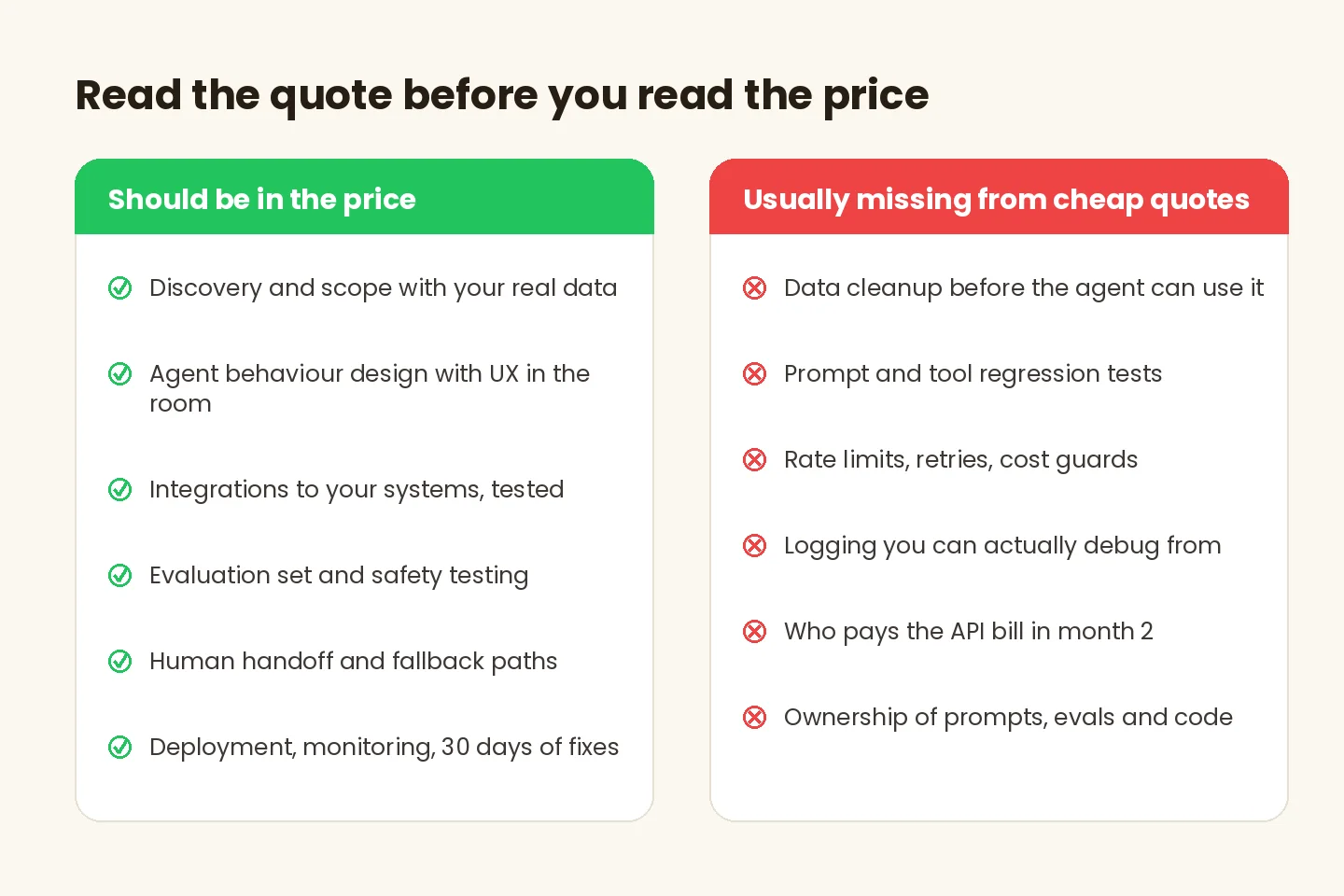
Checklist of what should be included in an AI agent development quote versus what cheap quotes usually leave out

6 questions to ask before you sign

Bring these to every vendor call. The answers tell you more than the price does.

  1. Which model, and what does it cost per month at my expected traffic? If they cannot answer, they have not scoped it.
  2. What is in the evaluation set, and who maintains it after launch?
  3. What happens when the agent is unsure? Show me the handoff screen, not a slide about it.
  4. Which of my systems does it write to, and what happens when one of them is down?
  5. Who owns the prompts, the evals and the code when we are done?
  6. What is the monthly cost in month 6, including your maintenance, if usage triples?

Frequently asked questions

How much does it cost to build an AI agent in 2026?

Between $5,000 and $400,000 depending on scope. A single-task workflow agent runs $5,000 to $20,000, a customer-facing agent with retrieval $20,000 to $60,000, a multi-step agent with system integrations $60,000 to $150,000, and multi-agent systems in regulated industries $150,000 and up. Healthcare and fintech add 25 to 40%.

What does an AI agent cost to run per month?

It depends on the model. For 10,000 conversations a month at September 2026 API prices, the model bill alone ranges from about $30 on GPT-5.6 Luna to about $1,350 on Claude Fable 5.1. Hosting, vector storage, monitoring and maintenance typically add 40 to 80% to the first-year total.

Why is AI agent development so much more expensive than a chatbot?

A chatbot answers. An agent acts. Acting means integrations with your systems, approval flows, retries, an audit trail and a way to hand off to a person. Integration engineering and safety testing alone account for 40 to 60% of a typical agent build.

How long does it take to build an AI agent?

A single-task agent takes 2 to 4 weeks. A customer-facing agent with retrieval takes 5 to 8 weeks. A multi-step agent with several integrations takes 8 to 14 weeks. At Elegant IT, an AI integration sprint runs about 3 weeks and a full AI-native product build runs 6 to 10 weeks.

Why do so many AI agent projects fail?

Gartner predicts over 40% of agentic AI projects will be cancelled by the end of 2027 because of cost, unclear value and weak risk controls. MIT research found about 95% of generative AI pilots delivered no measurable P&L impact. In our experience the cause is almost always scope, integration and trust, not the model.

Want a real number for your agent?

Book a free 15-minute call. Bring the workflow you want automated and we will give you a fixed price and a monthly running cost estimate, with the model choice explained.

Book a free call

Let us build your vision.

Book a 15-minute intro call. No pressure, just a fast look at what you want to build.

Schedule an intro call