Elegant IT
LinkedInFacebookTwitter
EU AI ActAI FeaturesCompliance

The EU AI Act Delay Does Not Cover What Your Users See

Two things happened in the same week of July 2026 and most coverage reported only one of them. The Digital Omnibus pushed the high-risk deadline out to December 2027. Article 50 transparency applied on 2 August 2026 anyway. If your product has a chatbot, a summariser or a copy generator, the delay you read about is not your delay.
AT
A.B.S. Tamal, Founder, Elegant IT Limited
8 min read · Published September 21, 2026
Article 50 of the EU AI Act, transparency obligations in force since 2 August 2026

The Digital Omnibus on AI entered into force on 27 July 2026, six days before the deadline everyone had in their calendar. It deferred the high-risk obligations under Annex III from 2 August 2026 to 2 December 2027, and for AI embedded in products already covered by EU product safety law, out to 2 August 2028.

That is a genuine reprieve. If you are building credit scoring, hiring software or clinical triage, you bought 16 months.

Everyone else read the same headline and relaxed, which is the expensive part. Transparency was never inside the deferral. Article 50 applied on 2 August 2026, on schedule, and it is the article that touches ordinary SaaS products: the support chatbot, the summariser, the thing that drafts the email, the voice agent in onboarding.

We have shipped 315 products since 2017. Almost every founder call since August has included some version of the same question, which is whether this applies to them. The answer is usually yes. The work is usually smaller than they are braced for, and it is engineering work, not a legal memo.
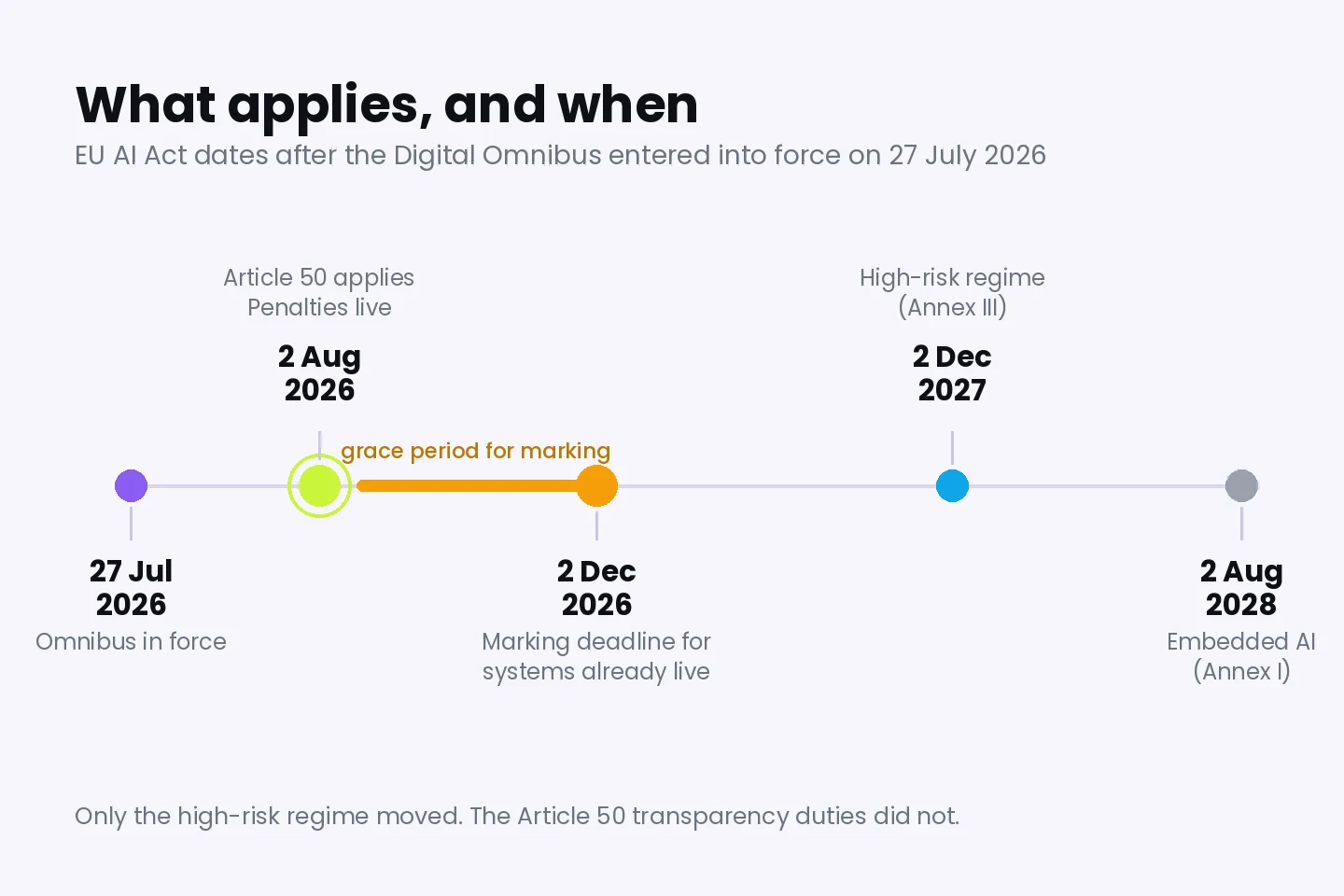
Timeline of EU AI Act dates: Article 50 on 2 August 2026, marking grace period to 2 December 2026, high-risk deferred to December 2027 and August 2028

The 4 duties, in product terms

Article 50 is not one rule. It is 4, and they land on different parts of the build.

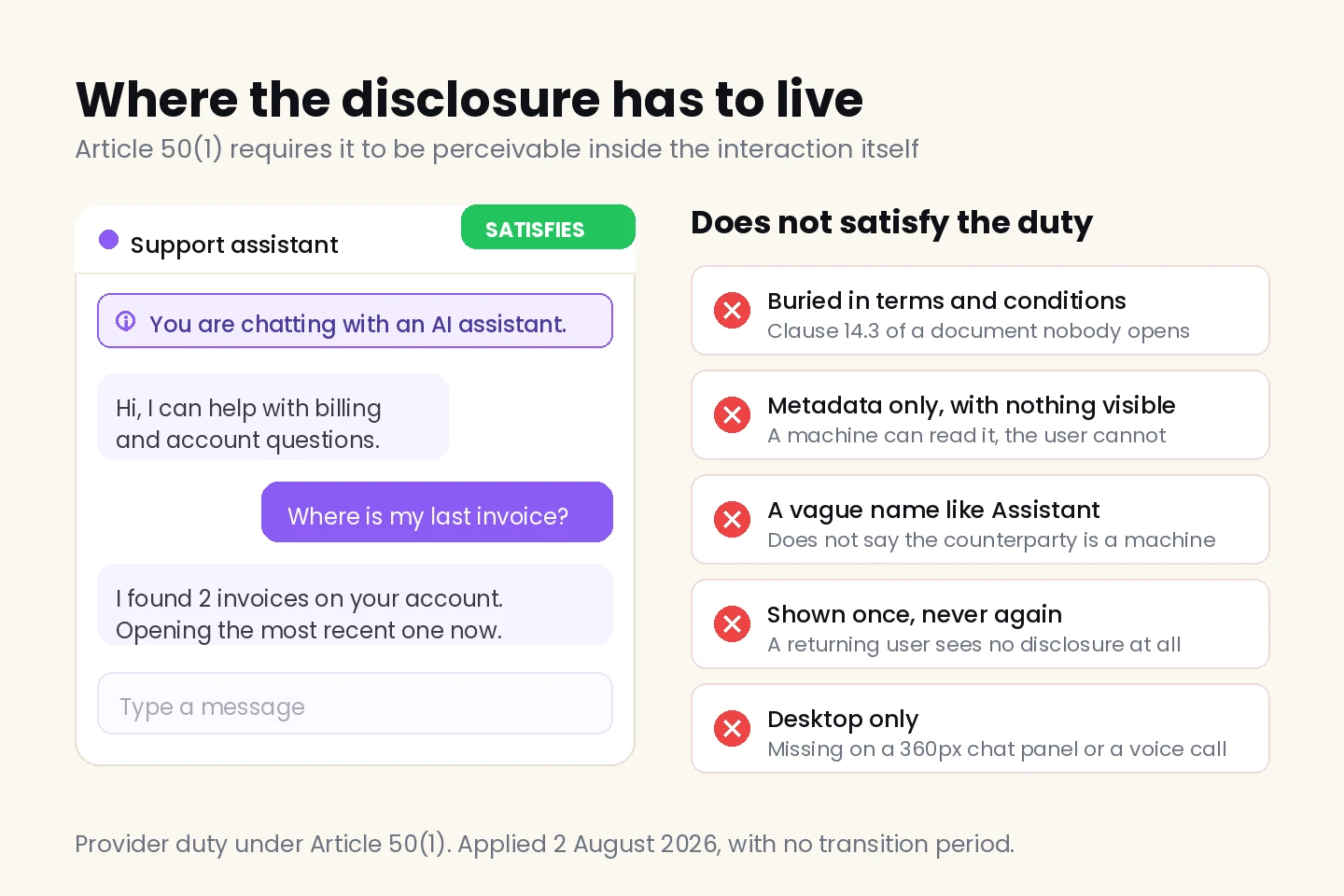
50(1), the machine disclosure. If your system interacts directly with a person, that person has to know they are dealing with AI. This is a provider duty and it is the one that catches most SaaS products. The Commission guidance is blunt about what does not count: a line buried in terms and conditions, a metadata tag on its own, or a vague label like Assistant. The information has to be perceivable inside the interaction itself.

50(2), the marking duty. Providers of generative systems have to mark output in a machine-readable format so it is detectable as artificially generated. Text, images, audio, video. In practice that means metadata, watermarking, or a provenance signal a machine can read later.

50(3), emotion and biometric inference. If you run emotion recognition or biometric categorisation, you tell the people exposed to it. Narrower, but absolute where it applies.

50(4), deepfakes and public-interest text. Deployer duty. Synthetic media gets disclosed on first exposure, clearly and distinguishably, and you cannot lean on the provider's machine-readable marking to satisfy it. Publishing AI-written text to inform the public on a matter of public interest carries the same duty, unless a human reviewed it and took editorial responsibility.

Article 50 dutyWho it lands onWhat you actually buildApplies from
50(1) Direct interactionProviderVisible disclosure at the start of every AI conversation, inside the interface2 August 2026
50(2) Marking generated outputProviderMachine-readable marking on generated text, images, audio and video2 August 2026, or 2 December 2026 for systems already on the market
50(3) Emotion and biometricDeployerNotice to the people the system is applied to2 August 2026
50(4) Deepfakes and public-interest textDeployerClear label on first exposure, plus an editorial review record where text informs the public2 August 2026
Annex III high-risk regimeProvider and deployerRisk management, logging, human oversight, conformity assessment2 December 2027, deferred by the omnibus

Article 50 sits outside the omnibus deferral. Only the high-risk regime moved.

The date almost nobody has noticed

There is one carve-out, it is narrow, and it expires in about 10 weeks.

Co-legislators agreed a targeted grandfathering rule for 50(2) alone. Generative systems placed on the market before 2 August 2026 have until 2 December 2026 to meet the marking requirement. Anything launched after 2 August complies from day one, and output already circulating before August does not have to be labelled retrospectively.

The relief stops there. The other three duties, 50(1), 50(3) and 50(4), applied on 2 August with no transition at all.

So if you shipped an AI writing feature in 2025 and have not touched it since, your position is specific: the disclosure duty has been live since August, and the marking duty lands on 2 December 2026. That is the deadline to put in the calendar. Somebody has to open a build ticket for it.

Where AI disclosure must appear in a product interface versus placements that do not satisfy Article 50

Perceivable is a design word, and that is the point

The standard is that disclosure must be timely, clear and intelligible, at or before the point of interaction. Lawyers wrote that sentence. Designers have to land it.

In a real product it comes down to a handful of decisions. Where does the line sit, and is it above the first message or below the fold. Does it survive on mobile, where your chat panel is 360 pixels wide and every element is fighting for room. Does it reappear in a new session, or does somebody who returns 3 weeks later see nothing. Does the voice agent say it out loud in the first few seconds, because a visual badge is useless on a phone call. Does your emailed AI summary carry it, given the email is the interaction for most of the people who receive one.

None of that is hard. All of it is specific, and it is the sort of detail that quietly does not get done when compliance is filed under legal and never reaches the sprint board.

The marking duty is the one teams underestimate. Detectable as artificially generated means a signal that survives the round trip: stored with the asset, carried through your CDN, still there after an image is resized or a document is exported. If your pipeline strips metadata on upload, and most image pipelines do, you have a real engineering task rather than a checkbox. Decide it at the architecture layer once, or retrofit it into every export path later.

Who is actually covered, and what it costs to get wrong

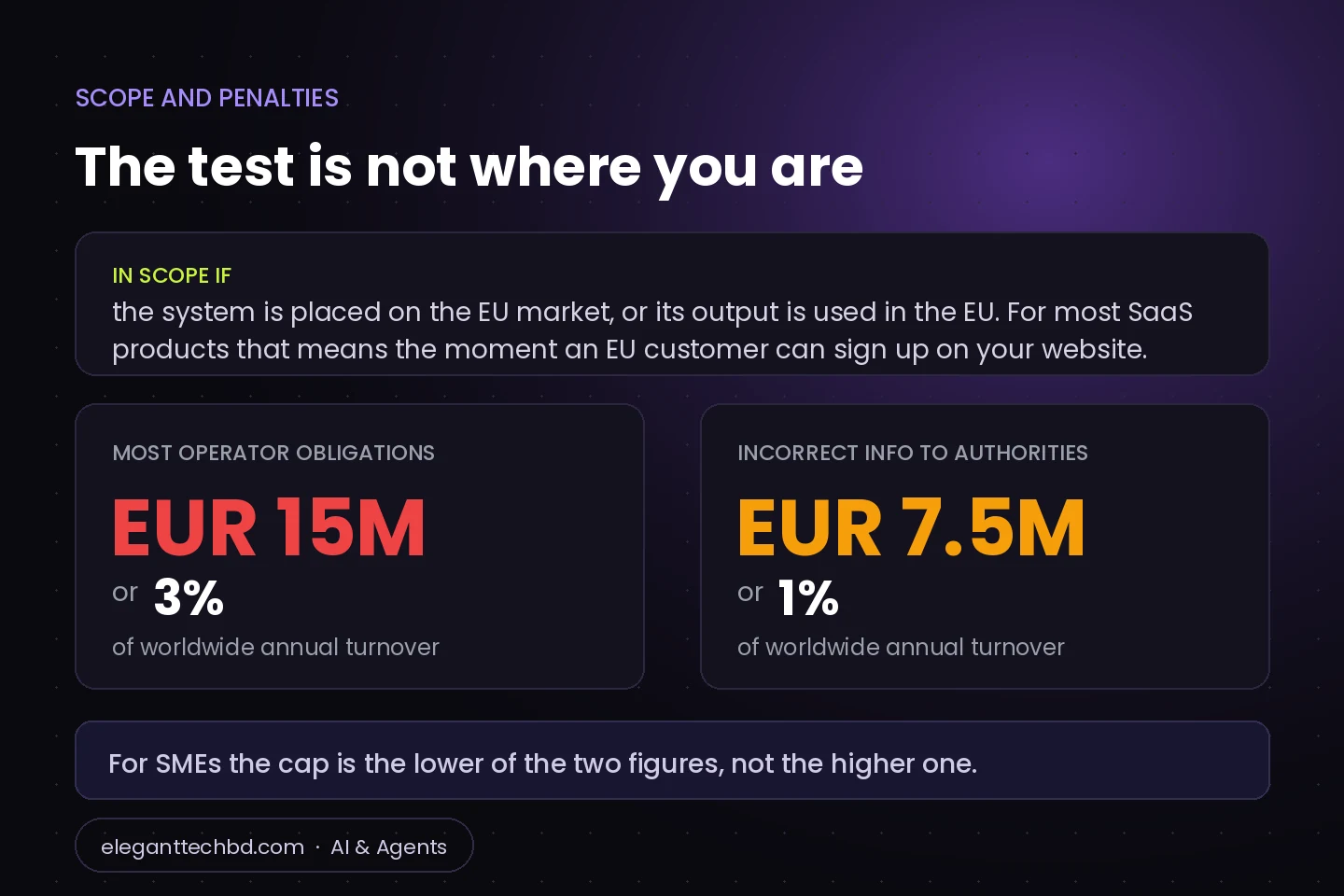
The reach works like GDPR. Location of your company is not the test. If the system is placed on the EU market or its output is used in the EU, you are in scope, which for most SaaS means the moment an EU customer can sign up on your website.

On penalties, the numbers that matter for ordinary products are 15 million euro or 3% of worldwide annual turnover for breaching most operator obligations, and 7.5 million euro or 1% for supplying incorrect or misleading information to authorities. For SMEs the ceiling is the lower of the two figures rather than the higher one. Enforcement powers and the penalty framework came into effect alongside Article 50 in August.

Realistically, a 12-person SaaS company is not the first target of a regulator with finite capacity. The nearer risk is commercial. Enterprise buyers started asking for this in procurement well before August, and a security questionnaire that asks how you disclose AI interactions and how you mark generated output is now routine. Answering it badly costs a deal long before it costs a fine.

What to ship before 2 December

A half-day audit and a short sprint covers most products. In order:

  1. Inventory every AI touchpoint. Chat, search, summaries, drafting, recommendations, voice, and anything a vendor bolted on that your team has forgotten about.
  2. For each one, decide whether you are the provider, the deployer, or both. The duty follows the role and this is where most teams mislabel their obligations.
  3. Put visible disclosure at the top of every direct interaction, including new sessions, mobile, embedded widgets and voice.
  4. Add machine-readable marking to generated output and verify it survives your resize, export and CDN paths. Test the round trip rather than the write.
  5. Write down the human review step for any AI-written text you publish as editorial, because that record is what the exemption in 50(4) rests on.
  6. Keep a one-page register of what you disclosed and where. When a procurement questionnaire arrives, that page is the answer.
EU AI Act scope test and penalty ceilings of 15 million euro or 3% and 7.5 million euro or 1% with the lower cap for SMEs

How we handle it

We treat transparency the same way we treat authentication, which is as a product layer decided in week 1 rather than a patch applied in week 9. When we scope an AI integration sprint for a product that is already live, the disclosure and marking work is part of the estimate rather than a change request after launch, and on a full AI-native product build it is written into the architecture before the first screen is designed.

The founders who are relaxed about December are the ones who built it in. The ones who are not are rereading a 2025 feature they inherited and trying to work out whether metadata survives their image pipeline.

If you want the longer view on what agentic features actually require once real users touch them, what agentic AI actually means in production covers the ownership and integration side of the same problem.

Frequently asked questions

Was the EU AI Act delayed in 2026?

Partly. The Digital Omnibus on AI entered into force on 27 July 2026 and deferred the high-risk regime under Annex III from 2 August 2026 to 2 December 2027, and to 2 August 2028 for AI embedded in products covered by EU product safety law. The Article 50 transparency obligations were not deferred and applied on 2 August 2026 as planned.

What does Article 50 of the EU AI Act require?

4 things. Systems that interact directly with people must tell those people they are dealing with AI, perceivably and inside the interaction. Providers of generative AI must mark output in a machine-readable format so it is detectable as artificially generated. Deployers of emotion recognition or biometric categorisation must notify the people exposed. Deployers must clearly label deepfakes on first exposure, and AI-written text published to inform the public unless a human took editorial responsibility.

Does the EU AI Act apply if my company is outside the EU?

Yes, if the system is placed on the EU market or its output is used in the EU. The reach is extraterritorial in the same way GDPR is. For most SaaS companies the trigger is simply that an EU customer can sign up and use the product.

Do I have to watermark AI-generated content in my product?

If you are the provider of a generative AI system, yes. Article 50(2) requires output to be marked in a machine-readable format, usually through metadata, watermarking or a provenance signal. Systems already on the market before 2 August 2026 have until 2 December 2026 to comply. Systems launched after 2 August 2026 comply from day one, and content published before August does not need retrospective labelling.

What are the penalties for getting Article 50 wrong?

Breaching most operator obligations carries up to 15 million euro or 3% of worldwide annual turnover, whichever is higher, and supplying incorrect or misleading information to authorities carries up to 7.5 million euro or 1%. For small and medium enterprises the cap is the lower of the two figures. The practical risk for a small SaaS company arrives sooner through enterprise procurement questionnaires than through a regulator.

Not sure which duties apply to your product?

Book a free 15-minute call. Bring the AI features you have already shipped and we will tell you which Article 50 duties land on you, what has to change in the interface, and what it takes to build before 2 December.

Book a free call

Let us build your vision.

Book a 15-minute intro call. No pressure, just a fast look at what you want to build.

Schedule an intro call