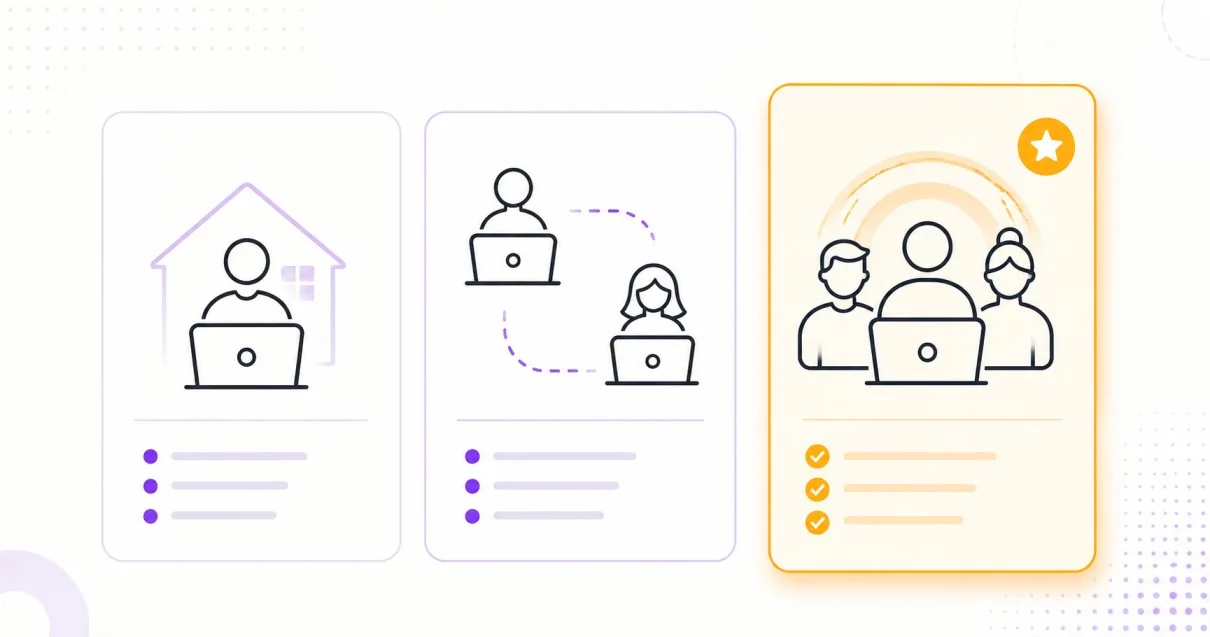
You have decided to build. The next decision is harder: who builds it. There are three real options and each one is sold to you with its best foot forward, so the trade-offs stay hidden until you are already committed. Here is the straight version for 2026.
Product Studio vs Freelancer vs In-House (2026)

The three options, side by side
| Option | Real cost | The hidden tax | Speed to start |
|---|---|---|---|
| In-house team | $210k–$380k per senior hire, per year, fully loaded | Recruiting takes months, you manage everyone, single points of failure | 2–4 months to hire |
| Freelancers | $40k–$120k+ at $75–$150/hr | Sourcing, uneven quality, no design-to-dev handoff, project management lands on you | 1–4 weeks |
| Product studio | $15k–$35k per fixed-scope build | You bring the direction, the studio executes; not built for ten parallel workstreams | Days to scope, weeks to ship |
Fully loaded in-house cost includes base salary plus 30 to 50 percent for benefits, taxes, and overhead, plus recruiting. A single senior developer in the US runs well over $200k a year before you have a designer or a product manager.
When each one actually wins
Hire in-house when
The product is your core engine, you will keep a full team busy for years, and you can afford to wait three months to start. Below full utilization you are paying $200k a head for part-time need.
Use freelancers when
You have a small, well-scoped task and someone internal who can art-direct, manage, and QA the work. The hourly rate looks cheap. The management time is the real price, and nobody budgets for it.
Use a product studio when
You need a whole product, not a piece of one, and you want design, engineering, and AI moving as one team on a fixed timeline and a fixed price. This is the default fit for founders going from idea to live product without building a department first.
The real problem with stitching it together yourself
The most expensive setup is the one most founders fall into by accident: a freelance designer, a separate developer, and an AI contractor, all coordinated by you. Every handoff between them is where time and quality leak. The designer ships a file the developer interprets differently. The AI gets bolted on at the end instead of built into the core. You become the project manager for a team that has never worked together.
A studio removes the handoffs because the people are already one team. That is the difference between three vendors and one outcome.
A simple way to decide
Ask one question: do you need a person, a task, or a product? A person you will keep busy for years means hire. A small task you can manage means freelance. A product you need live in weeks means a studio. Most founders at the idea-to-launch stage need a product, and they spend months learning that the expensive way.
Frequently asked questions
Is a product studio cheaper than hiring in-house?
For a single product, yes. A fixed-scope build runs $15k to $35k. One senior in-house hire runs over $200k a year fully loaded, and you need several to cover design, engineering, and AI.
Should I use a freelancer or an agency for my startup?
Use a freelancer for a small, well-scoped task you can manage yourself. Use a studio when you need a complete product and do not want to coordinate separate vendors.
What is the hidden cost of freelancers?
Management time. The hourly rate is visible, but sourcing, coordinating, QAing, and covering the gaps between a designer and a developer falls on you and rarely gets counted.
How fast can a studio start versus hiring?
A studio can scope in days and ship in weeks. Hiring a senior team in-house typically takes two to four months before any code is written.
Not sure which fits your stage?
Book a free 15-minute call. We will tell you honestly whether you need a studio at all, and what a realistic scope looks like.
Book a free call ↗Continue reading
Let's build your vision.
Book a 15-minute intro call. No pressure, just a fast look at what you want to build.
Schedule an intro call ↗