Elegant IT
LinkedInFacebookTwitter
EngineeringArchitectureMVP

Build an MVP Architecture That Scales

Most MVPs are not killed by the market. They are killed by their own foundation. A few architecture decisions in week one decide whether you scale smoothly or end up rebuilding the plane while flying it.
AT
A.B.S. Tamal — Founder, Elegant IT Limited
5 min read · Published May 26, 2026
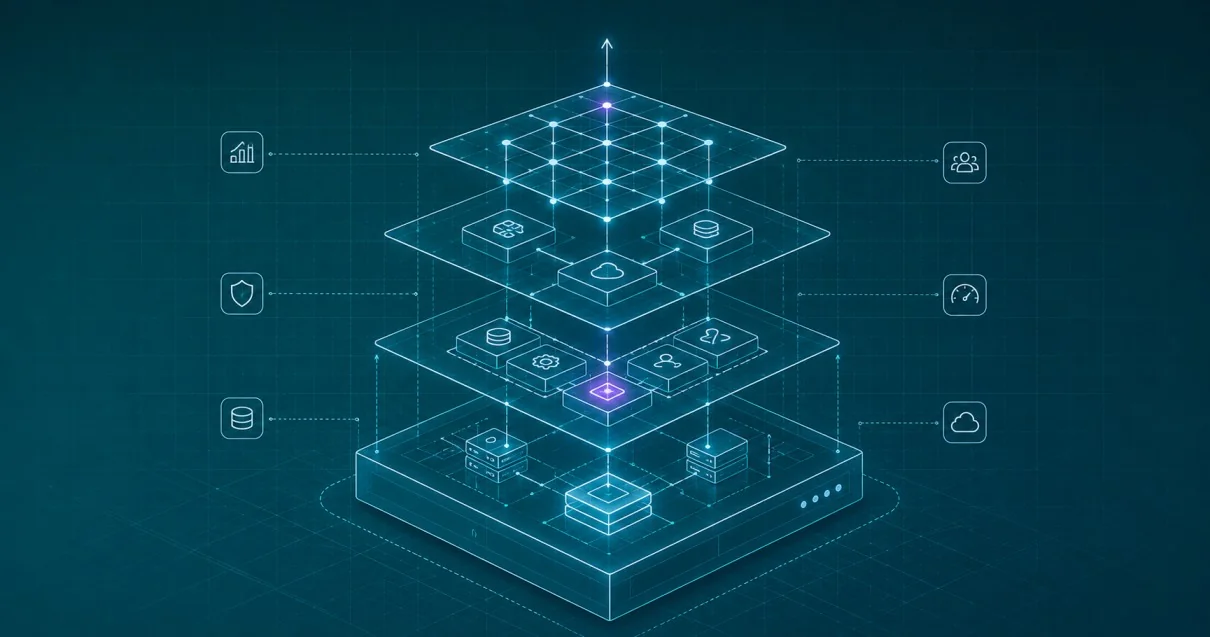
Scalable MVP architecture concept for 2026

Most MVPs are not killed by the market. They are killed by their own foundation. The product finds traction, users pour in, and the thing that was built fast to prove the idea cannot carry the weight. Now you are rebuilding the plane while flying it. A few architecture decisions in week one decide whether that happens to you.

Move fast is not the same as build sloppy

There is a myth that speed and solid foundations are opposites, that you either ship fast or build to last. That is a false choice. A senior team ships fast precisely because it knows which decisions are cheap to change later and which ones are not. You cut corners on the cosmetic and the reversible. You do not cut corners on the few choices that are expensive to undo.

The decisions that are expensive to undo

Multi-tenancy. If you are building SaaS, whether each customer's data is cleanly separated is a foundational choice. Retrofitting multi-tenant architecture onto a single-tenant app is one of the most painful rebuilds there is. We build multi-tenant ready from the start for exactly this reason.

Data model. How your core entities relate is the spine of the product. A rushed data model leaks into every feature you build on top of it, and untangling it later touches everything.

Auth and permissions. Roles and access feel simple at launch with one user type. The moment you add teams, admins, or client logins, a shortcut here turns into a security and rework problem.

Where AI lives. If AI is part of the product, building it into the core from day one is a different architecture than bolting a chatbot on at the end. The first scales with the product. The second has to be torn out and redone.

The decisions you should not over-engineer

The opposite mistake is just as costly: building for a million users you do not have yet. You do not need microservices, multi-region infrastructure, or a custom platform team to validate an idea. Premature scaling burns the runway you needed to find product-market fit. The skill is knowing the difference, and that is what experience buys you.

A simple test for your build

Ask your team one question about any shortcut: if this works and we grow ten times, does this choice cost us a weekend or a rewrite? Weekend-level choices are fine to defer. Rewrite-level choices — the data model, multi-tenancy, auth, where AI lives — are the ones to get right while the product is still small and cheap to shape.

This is the same reason good UX is not a polish layer added at the end. The structure underneath decides what is possible on top.

Frequently asked questions

What is scalable MVP architecture?

It is building the few foundational choices — data model, multi-tenancy, auth, and where AI lives — correctly from day one, so the product can grow without a rebuild, while keeping everything else lean enough to ship fast.

Should an MVP be built to scale?

It should be built so the expensive-to-change parts are right and the rest stays simple. You do not build for a million users on day one, but you also do not make foundational choices that force a rewrite at your first growth spike.

What is multi-tenant architecture and do I need it?

Multi-tenancy keeps each customer's data cleanly separated within one system. If you are building SaaS, deciding this early matters, because retrofitting it later is a major rebuild.

How do I avoid technical debt in an MVP?

Get the foundational decisions right — the data model, auth, and core structure — and consciously defer only the reversible shortcuts. Debt becomes dangerous when the irreversible parts are rushed.

Want an MVP that scales?

We build products multi-tenant and AI-native from week one. Book a free 15-minute call and we will walk through your scope.

Book a free call

Let's build your vision.

Book a 15-minute intro call. No pressure, just a fast look at what you want to build.

Schedule an intro call